

Is Flux 2.0 the ultimate storytelling tool?
We tested the new multi-reference workflow against Midjourney, Flux, and Nano Banana Pro.

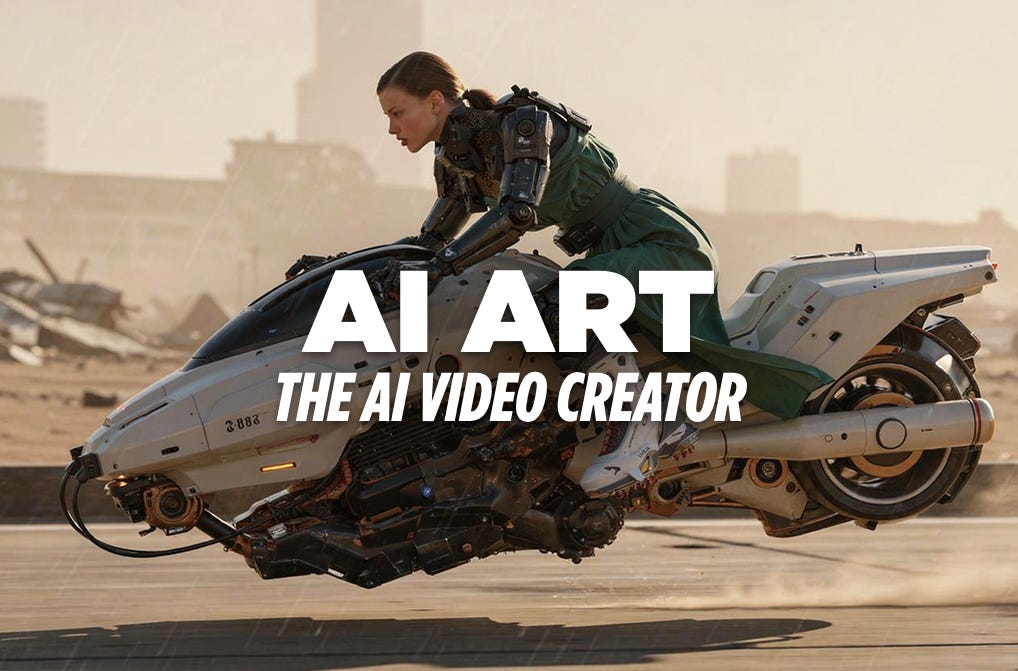
Flux 2.0 is the latest family of state-of-the-art AI image generation models from Black Forest Labs. It builds on the massive success of the original Flux 1 series, shifting the focus toward production-grade workflows for serious creators, designers, and developers.
When Flux 1.0 dropped, it was a watershed moment. Before that, Midjourney reigned supreme. Flux 1.0 broke that aura of invincibility.
But the field has shifted rapidly. Today, Midjourney is still the undisputed King of Style, but it lacks the control required for complex narratives. For pure versatility and consistency, Nano Banana Pro and Seedream 4.0 have recently taken the top spots.
That is precisely the gap Flux 2.0 aims to close. It promises three key advancements:
Photorealistic Fidelity: Outputs up to 4 megapixels with calculated lighting and physics to banish the smooth “AI plastic” look.
Advanced Typography: State-of-the-art rendering for complex text, logos, and manga panels.
Multi-Reference “Ingredients”: Support for up to 10 reference images simultaneously, allowing you to lock in characters, props, and styles without training a LoRA.
Let’s bring Flux 2.0 into the ring and see if it can go the distance against the heavyweights.
One of the advantages of Flux 2.0 is that it’s already accessible on most platforms: I used Freepik of these tests, but ImagineArt, Krea.ai and Higgsfield are already offering it.
Let’s go.
Round 1: Photorealism & Detail
We started with a stress test for skin texture, lighting, and complex accessories.
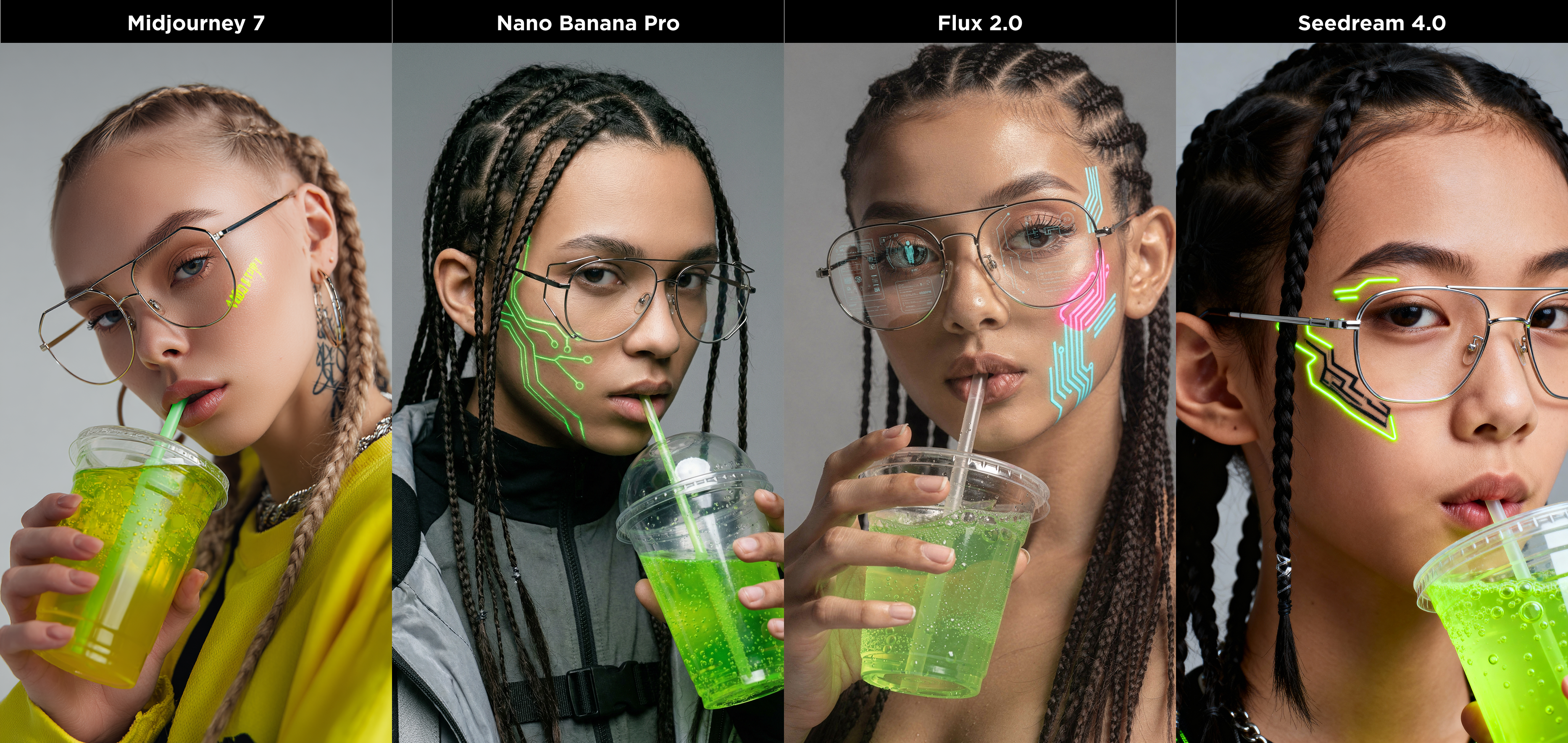
Prompt: Close-up high-fashion portrait of a young scifi character with braided hair, wearing oversized wireframe glasses, drinking a neon green bubbling tea in a plastic cup, neon tattoo in the face, neutral gray background, soft studio lighting, clean and minimalist editorial style.
The Verdict:
Midjourney 7 is undeniably beautiful, it captures that soft, editorial “vibe” perfectly. However, the tattoo is timid, almost hidden.
Nano Banana Pro leans into a raw, unfiltered sharpness
Flux 2.0 strikes a balance. Notice the glasses in the Flux render: the reflections aren’t just light; they look like a digital HUD interface, adding a layer of sci-fi storytelling the prompt hinted at but didn’t explicitly demand. The “circuit board” neon tattoo on the cheek follows the curvature of the face perfectly. It loses the “gloss” of Midjourney but gains the “grit” of reality.
Round 2: The Manga Text Test
For graphic novelists, the ability to render specific dialogue inside a speech bubble is the Holy Grail.
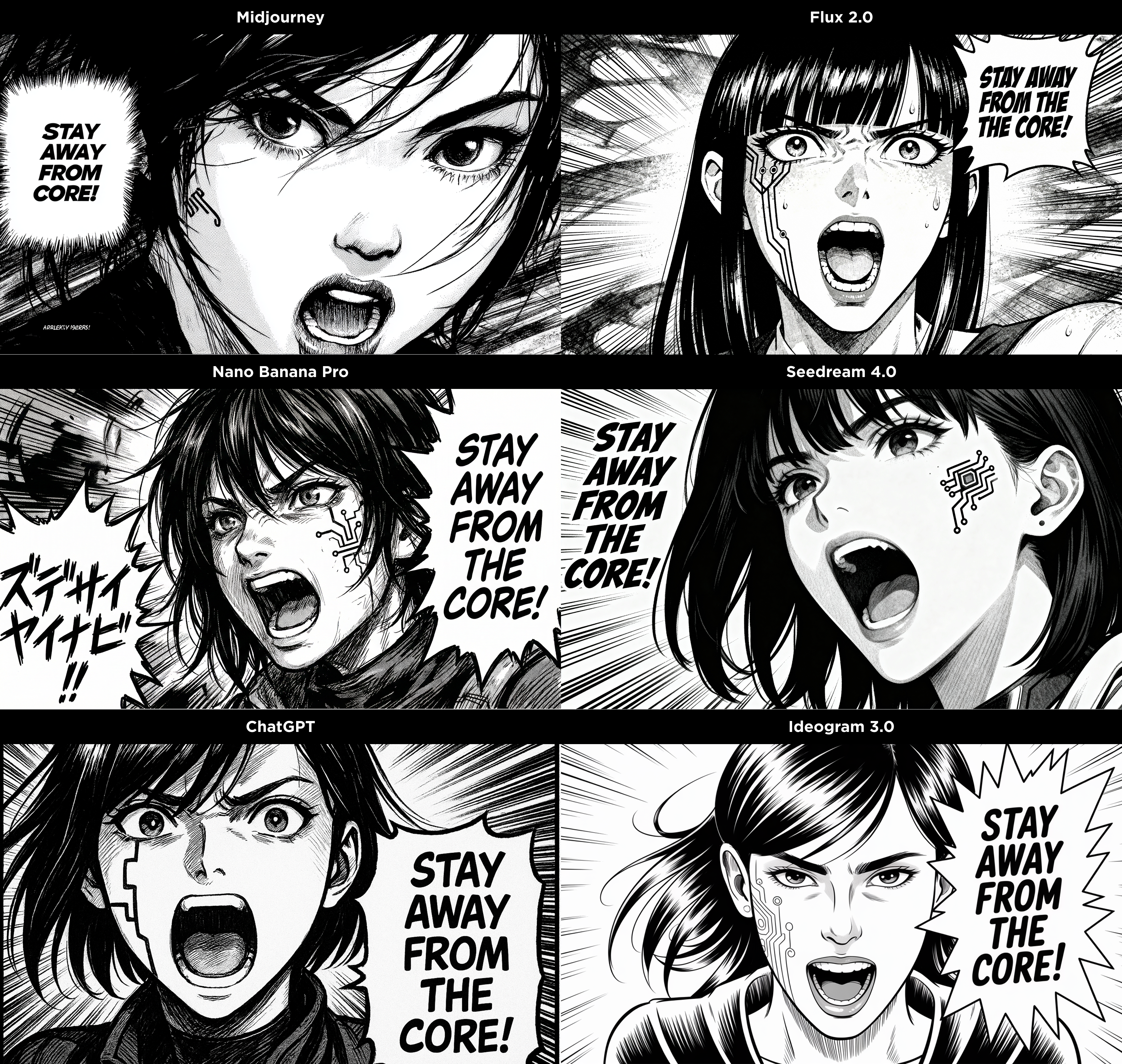
Prompt: Manga panel, close up of the face of young woman with black hair and side-swept bangs, single cyber circuit tattoo in her face, screaming the words “STAY AWAY FROM THE CORE!”, dynamic lines, black and white ink, high contrast shading, intense line art.
The Verdict:
This is where the older models fall apart and the new generation shines.
Midjourney struggles significantly here. The art is gorgeous, but the text is a hallucination, ”STAY AWAY FROM CORE” is barely legible.
Nano Banana Pro gets the intensity right, but adds unnecessary, garbled symbols on the side.
Flux 2.0, however, nails it. The text “STAY AWAY FROM THE CORE!” is perfectly kerned, centered, and legible. More importantly, the ink style feels authentic to the medium. It doesn’t look like a 3D render with a filter; it looks like pen and ink.
Round 3: The Consistency “Holy Grail”
This is the big one. Being able to assemble a scene with a consistent character, specific items, and a set location is the key to unlocking long-form projects like comics or storyboards.
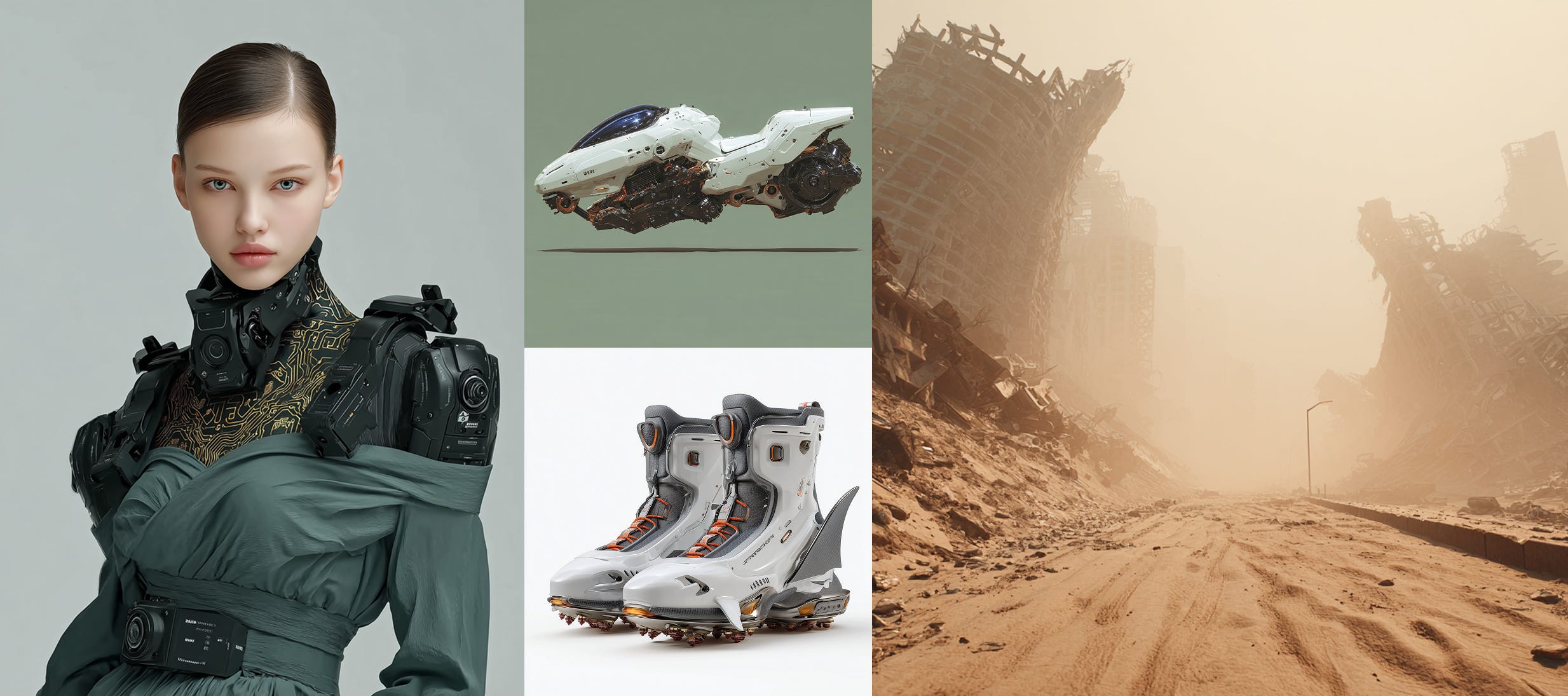
Flux 2.0 introduces a “Multi-Reference” workflow where we can feed it “ingredients.” We tested this against the current consistency leaders, Nano Banana Pro and Seedream 4.0.
The Recipe:
@char1: Woman with robotic body/green dress
@img2: Specific boots
@img1: Maglev speeder
@img3: Wasteland background
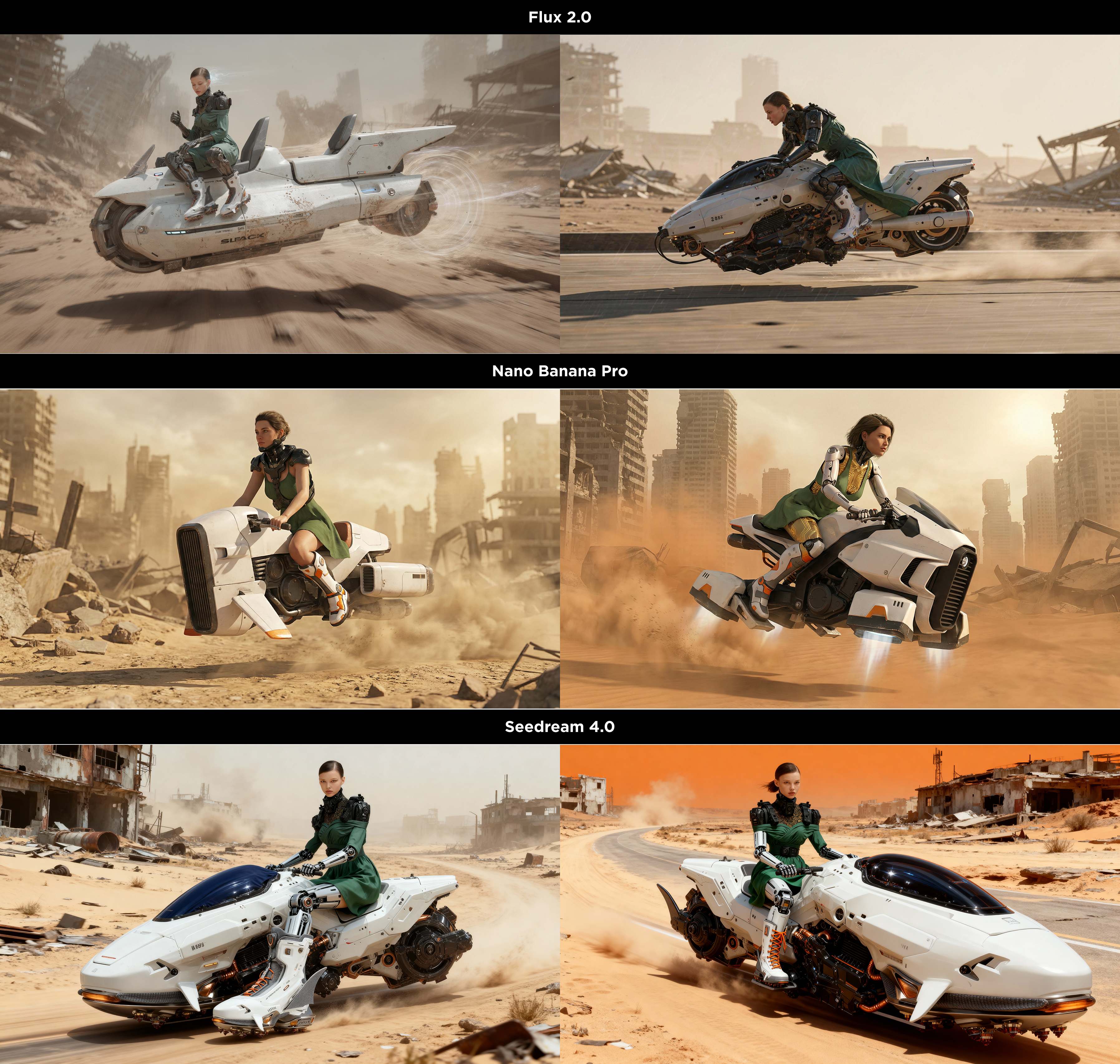
The Verdict:
Flux 2.0 holds its own in a brutal category. Looking at its second result, it successfully merged all four inputs. It kept the white chassis of the speeder, the green of the dress, and the specific wasteland aesthetic.
Where Seedream 4.0 produced a very high-fidelity vehicle, Flux 2.0 seemed to blend the lighting of the character into the environment more naturally. The woman sits in the speeder, not just on it.
While Nano Banana Pro is still a beast for consistency, its adds a lot of changes to the ingredients
Final Thoughts
Flux 2.0 isn’t just a generic update; it’s a pivot toward utility.
If you just want a pretty picture, Midjourney is still hard to beat. But if you are a creator building a graphic novel, a storyboard, or a consistent brand asset, Flux 2.0 has just become an essential tool in your kit. It combines the text accuracy of a graphic design tool with the consistency of a trained model.