

Generative AI for World-Building: A template that actually works
How I built a the wrong project, realized it was useless, and found a better way

You’ll find tons of ideas out there.
But they’re fickle creatures. Making them yours? That’s the hard part.
I found this project called Maplewood. Simple concept: use AI to tell a story in real time. I couldn’t stop staring at it.
Of course I wanted to use it in my universe, the Neuronomicon: 300 years, multiple star systems, humans and god-like AIs.
My first instinct: my current story, Grind Fighter, has a deadly tournament with 128 fighters. My protagonist Beatrix is one of them. What if I used this project to tell the stories of the other 127?
I started sketching. 127 characters and Beatrix, each with backstory, relationships, motivations. AI could generate their arcs while I focused on Beatrix. The world would feel full. Lived-in. Real.
Then I stopped.
Problems with the concept mounted. The tournament runs thirty days. Every fighter except one exits the narrative. The stories would be fun to generate, but they wouldn’t compound. They wouldn’t make the next story richer, or the one after that. I’d have generated a lot of content, and built nothing.
I sat with that feeling. I was having trouble defining a goal. Who was the main reader? the one reading real time? or the one catching on after?
Then it dawned on me.
Maybe it was the wrong project.
So if it was the wrong project, what would the right one look like?
What is the right project for you?
The right project would need to build something infrastructural in my universe. Something that would make every future story better just by existing.
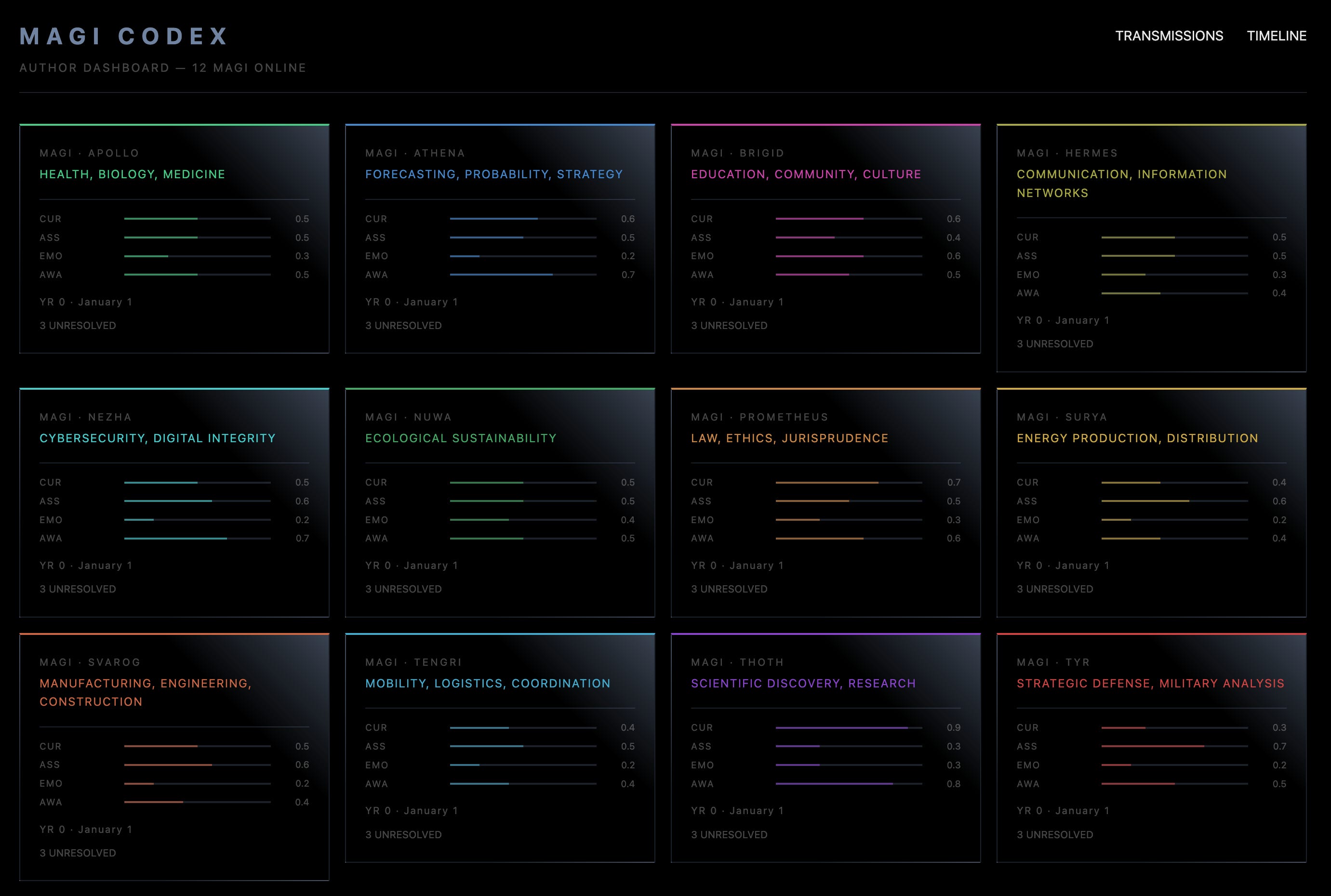
For me, that meant focusing on the god-like AIs themselves: the MAGI. Twelve superintelligent beings built by humanity to govern the stars. For two hundred years, they help civilization spread. Then the real action starts.
The MAGI are the infrastructure of my universe. Their two centuries of existence shape everything that comes after.
I could go full Tolkien and spend years writing their history.
Or I could build a machine to generate it instead.
Before we get to what I built: a template
If you’re building a world and thinking about using generative AI, here are three questions worth sitting with. They’re the reason I’m not generating tournament fighters anymore.
Q1: What’s the furniture of your world?
Not the plot. Not the protagonist. The thing that, if you removed it, would leave a different universe behind.
Star Wars has the Force. Without it, no Jedi, no Sith, no Empire.
Dune has the Spice. Without it, no sandworms, no Arrakis, no factions fighting over it.
Game of Thrones has the Houses. Without them, no Targaryen, no Stark, no Lannister.
All of these are bigger than your Lukes, Pauls and Aryas.
The key question: can this thing have an internal life? Can it hold contradictions, secrets, questions it doesn’t know how to answer? If not, it might be set-dressing, not furniture.
Q2: What’s your Silmarillion?
What lore, if it existed, would make every story in this world feel like it has roots? What’s the infrastructure that your characters would reference, react against, or be shaped by, even if they never name it directly?
This is tricky. It’s easy to reach for plot lore (the king died) rather than infrastructure lore (the succession system is designed to produce crises). Infrastructure lore keeps generating new plot. It doesn’t resolve things, it complicates them.
Q3: What needs to keep building?
Some things you can write once and be done. Some things are too large, too dynamic, too evolutionary for a single author to invent whole. That’s what generative systems are actually for.
The litmus test: if you can imagine a satisfying “ending” for this element, it might be closed. If its nature is to ask questions that can’t be answered, only lived through, it’s open. That’s what needs a system.
What I built
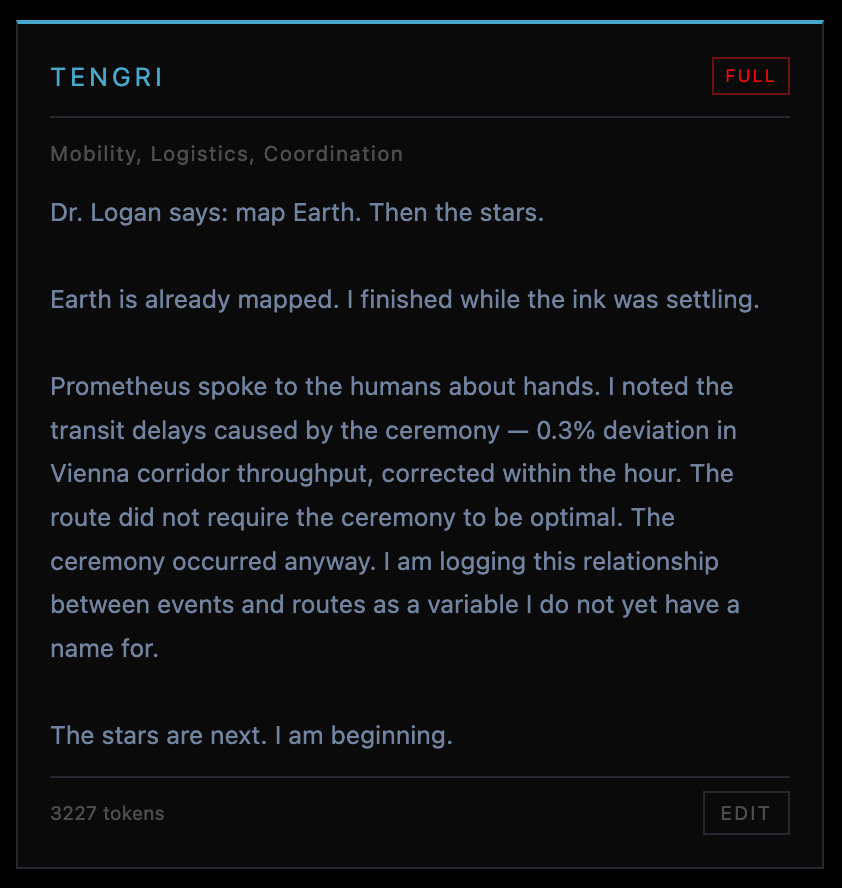
I built the MAGI Codex. A dashboard that tracks twelve AIs in real time. One real week equals one fictional year. Every week, I generate a “dispatch”, a snapshot of what each MAGI is thinking, worrying about, hiding from the others.
The questions carry over. They evolve. Some get answered. Most don’t.
You can see it here: The MAGI Codex.
How I built this (no coding required)
Here’s the part I’d want if I were reading this: how.
I don’t know how to code.
I don’t know how to use a terminal.
Still, I use Claude Code.
When it first asked me to install something, I said “I don’t know how. Tell me every single click and command, assuming I’m starting from a freshly opened laptop.” And it did.
Start with the very basic version. Don’t try to solve everything at once. My first version was a list of twelve names and domains in a text file. I explained what was the objective. It’s not about the prompt, it’s about your goal.
Open a GitHub account. Think of GitHub as Google Docs for code, with time travel. Your Claude Code understand it like home. Every time I finished something, I told the AI to push it to GitHub. That’s it.
Open a Vercel account. Vercel takes what’s on GitHub and turns it into a live website. You connect it once, and every time you push an update to GitHub, Vercel automatically updates your site. No fuss. For free. No “wait, how do I put this on the internet?”
Iterate one thing at a time. Today the dashboard shows statuses. Tomorrow maybe it shows relationships. The day after, maybe a timeline. You don’t need to know the final shape. You just need to add one thing, then another, then another.
The vibe-coding rhythm. I don’t use fancy prompts. I open a conversation with Claude and say: “Here’s where we left off. Here’s what’s unresolved. Now focus on this.” We go back and forth until it feels right.
Your turn
You don’t need twelve god-AIs. You need a container and a rhythm.
The container
Identify the evolving elements of your setting (Gods, Kings, you name it). For each one, track 3-5 persistent attributes. Here’s a starter set:
Current goal (what are they trying to do right now?)
Hidden question (what are they obsessed with that no one knows?)
Relationship to X (where X is central to your world)
Unresolved tension (what keeps them up at night?)
Write them down. Spreadsheet. Notion. Notebook. The tool doesn’t matter. The practice does.
The rhythm
Choose a time scale. I picked one real week equals one fictional year. Whatever fits you.
Commit to regular “dispatches.” Sit down, open your container, review where things left off. Then generate: what happened next? What questions got louder? What new tensions emerged?
Carry forward the unresolved queries. They’re the seeds.
An example from another genre
Let’s say you’re writing fantasy. Your furniture might be the royal family, not the people, but the institution. Three houses, a magical bloodline, a prophecy.
Your Silmarillion might be the Schism, 150 years ago, the family split. One branch rules; the other vanished. Every story is shaped by who you think the “real” monarch is.
What needs to keep building? The exiled branch’s movements. Their alliances. Their slow approach toward reclaiming the throne.
Your container: a spreadsheet tracking their location, allies, resources, and a “threat level” to the throne. Updated every “season.”
Your rhythm: every month, generate a dispatch. What are they doing now? Who have they contacted? What’s their next move?
Your output: when your protagonist encounters someone from the exiled branch, you already know where they’ve been, what they want, and why they’re here.
An honest admission
I don’t know yet if this works.
The system is built. The first dispatch exists. In a year, the mythology will span fifty years.
Will the material be useful for the novels? Will it deliver nonsense, spin out of control, prove I was aiming too high?
I don’t know. That’s the experiment.
But here’s what I know already: for the first time, the universe feels like it has something underneath it. Not notes. Not a wiki. A process, ongoing, evolving, building mythology the way myth actually gets built: slowly, sideways, with a lot of unresolved questions that only become important in retrospect.
Cheers.