

I tried to map my sci-fi world. Claude Code couldn't understand me. Until I drew it
Turns out, Claude Code needs to see your world, not just read about it

Halo. Ringworld. If you are into sci-fi, you know what these mean.
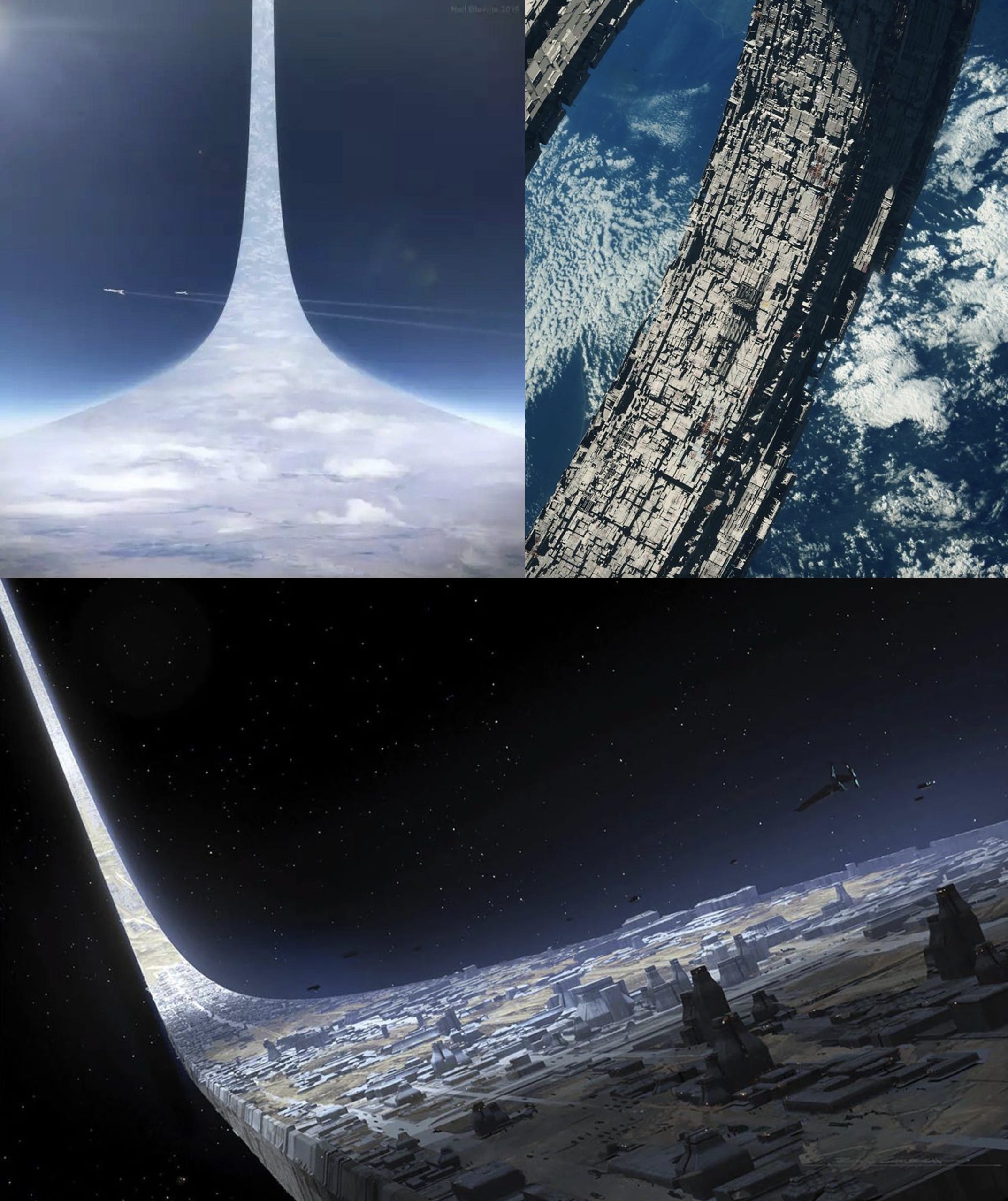
A world structure so big, so extreme, that it numbs your mind.
Of course I’m using one in my setting.
Of course I’m building one now with Claude Code.
Ilion.
But before I could build it, I had to understand what it actually was.
Ilion isn’t a planet. It’s not a space station. Inspired in a Dyson Sphere, it’s a massive structure orbiting a star in rough synchronization. For me, it’s the setting for Grind Fighter (Read it Royal Road). It’s where Beatrix scavenges, where the clans run their territories, where the story lives.
And I had no idea on how to map it.
That’s a problem. You can’t write a world you can’t see. So this week, I tried to build a map of it.
What followed was one of the most instructive failures I’ve had with AI yet.
The project that cracked it open
A few days ago I found git-city. It’s an amazing concept.
A project that generates a 3D wireframe city from your GitHub profile. Each repository becomes a building. Commit frequency drives the height. Stars determine the window count. Abandoned repos become ruins.
I stared at it for a while.
The insight landed slowly: the same generative logic could build Ilion. Because Ilion isn't random, it has a history. It's an impossible place built by a space gold-rush. Prospectors came first, then corporate rigs, then the AI Gods and everyone and their mothers. Each era of construction has its own zone, its own aesthetic. The ring grew in layers, not in plan.
A git history is a growth record. So is Ilion.
The mechanics practically write themselves:
Each GitHub repo → a station or district on the ring
Stars → economic level of the district
Commit frequency → construction speed; active repos are still being built
Contributors → named droid units (the lore already has tireless droids welding in the void)
Abandoned repos → derelict sections, flickering orange in the dark
Branches → parallel construction projects, some merged into the ring, some floating incomplete
I gave it to Claude Code. Within a session we had a live wireframe ring at neuronomicon.world, auto-loading from my GitHub profile, with station inspectors and a MAGI terminal log running in the corner.
The data-to-world translation worked beautifully. That part was easy.
Where it broke down
A Dyson ring is not a standard shape. It’s a structure you live inside, a giant rotating cylinder where the inner surface is the ground, and the star is the sky. Gravity doesn’t pull you toward the ground. It pulls you outward, away from the star, toward the hull.
When I asked Claude Code to render the drone view, the camera flying above the surface of the ring, it couldn’t get this right. Repeatedly.
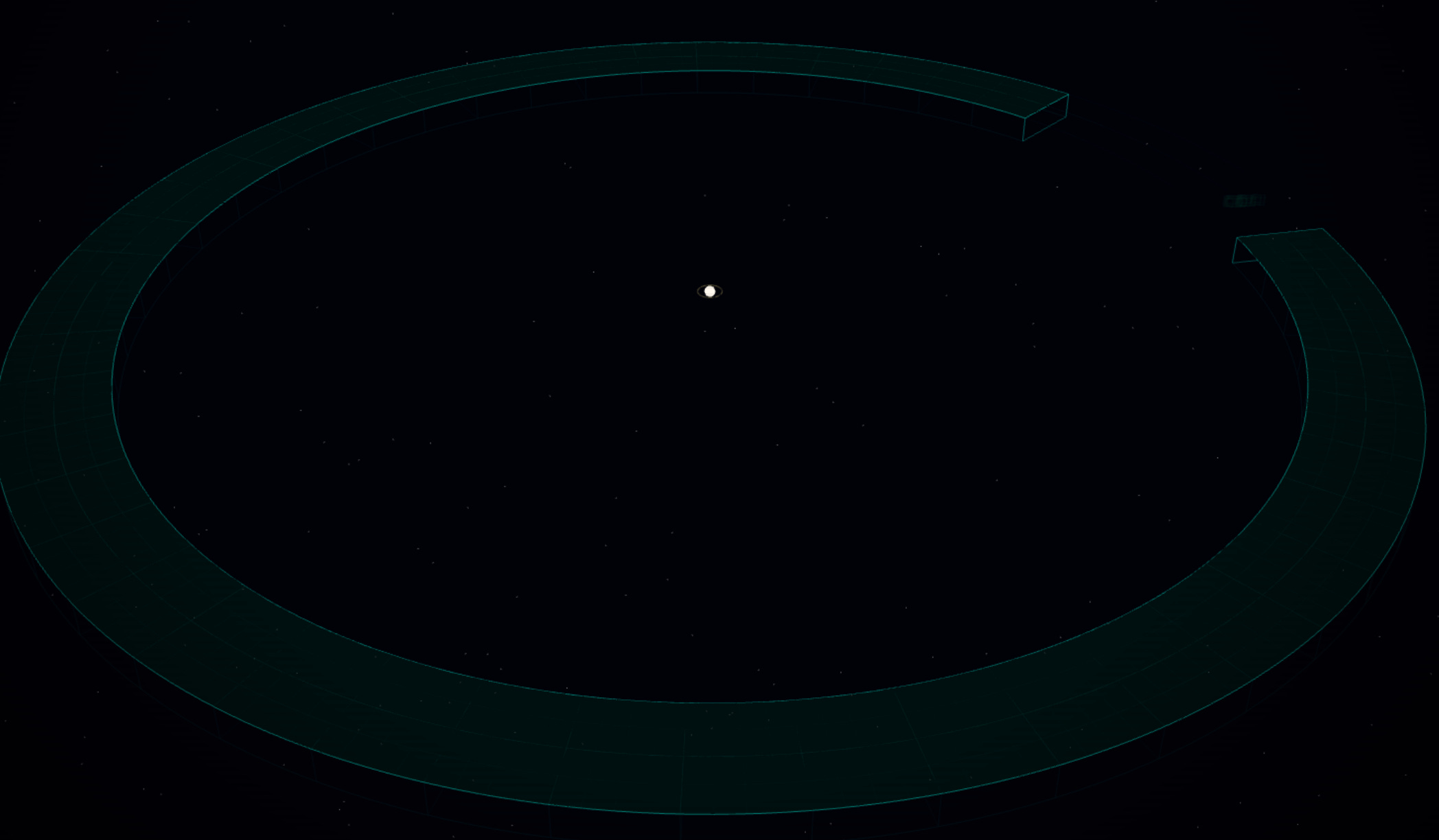
It kept placing the camera on the large surface. Or the ring appeared as a flat disc floating in space instead of a thin arc.
I wrote descriptions. Detailed, careful, specific descriptions. “The inner surface faces the star. The habitable surface is the interior of the ring, not the exterior.” The outputs were reasonable attempts at something, but not the thing I meant.
The moment I stopped writing and started drawing
Here’s what broke the loop: I stopped trying to describe it and drew it on Figma instead.
I made a quick annotated diagram, two views side by side, labeled “Wrong view” and “Good view.” In the wrong view, I drew what Claude Code kept generating: the outer hull as the dominant surface. In the good view, I drew what I actually needed: the inner face, thin, with the arc curving away toward the star.
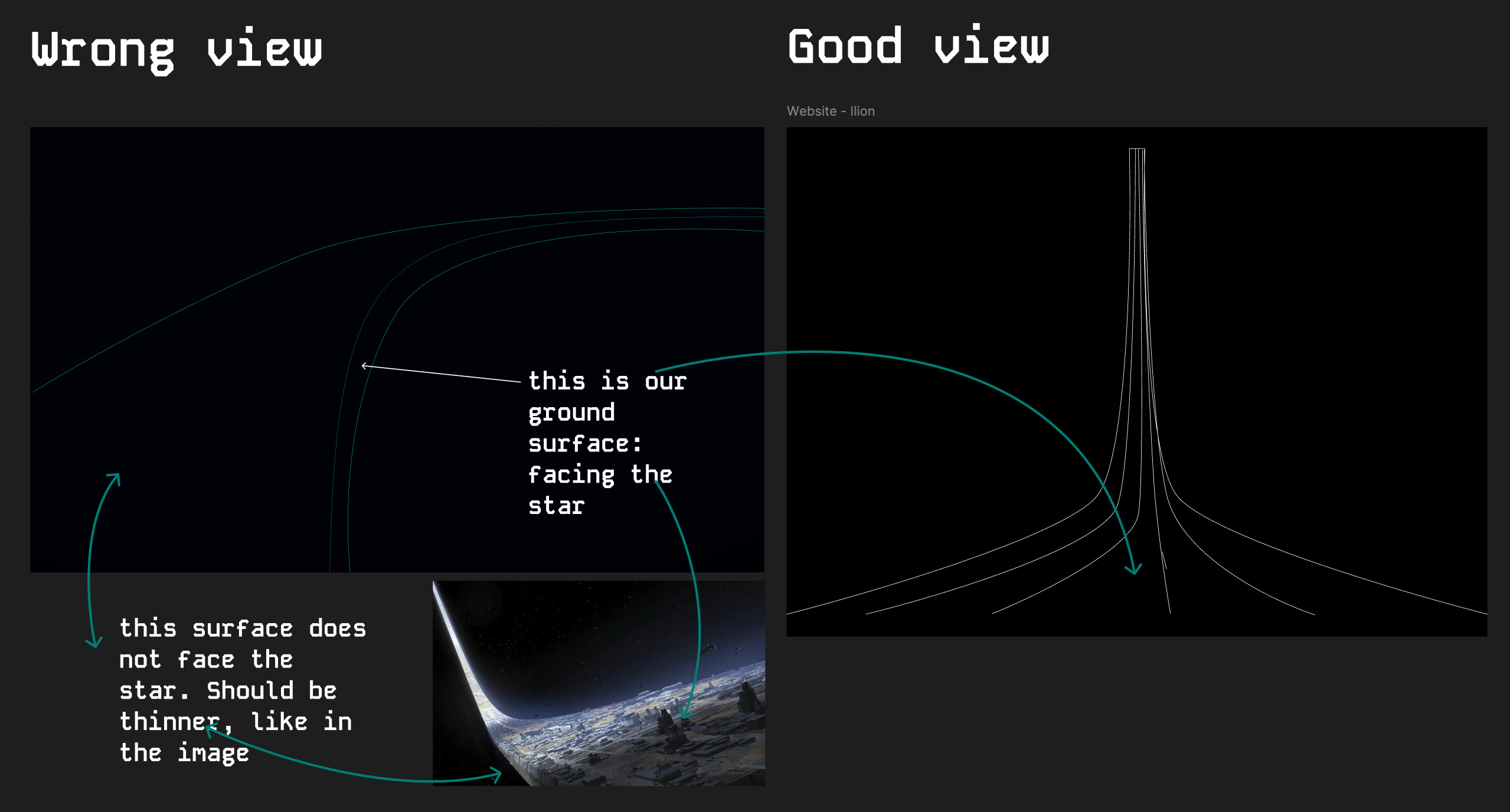
I uploaded the diagram alongside the prompt.
Everything changed immediately.
The next output had the geometry exactly right. The camera positioned above the inner surface, the ring curving upward on both sides, Troy as a faint point in the “sky” above, the outer hull disappearing below like a foundation.
The description I’d been writing for an hour was less useful than a thirty-second sketch.
The second thing I had to learn
Once the geometry was right, a new problem appeared: scale.
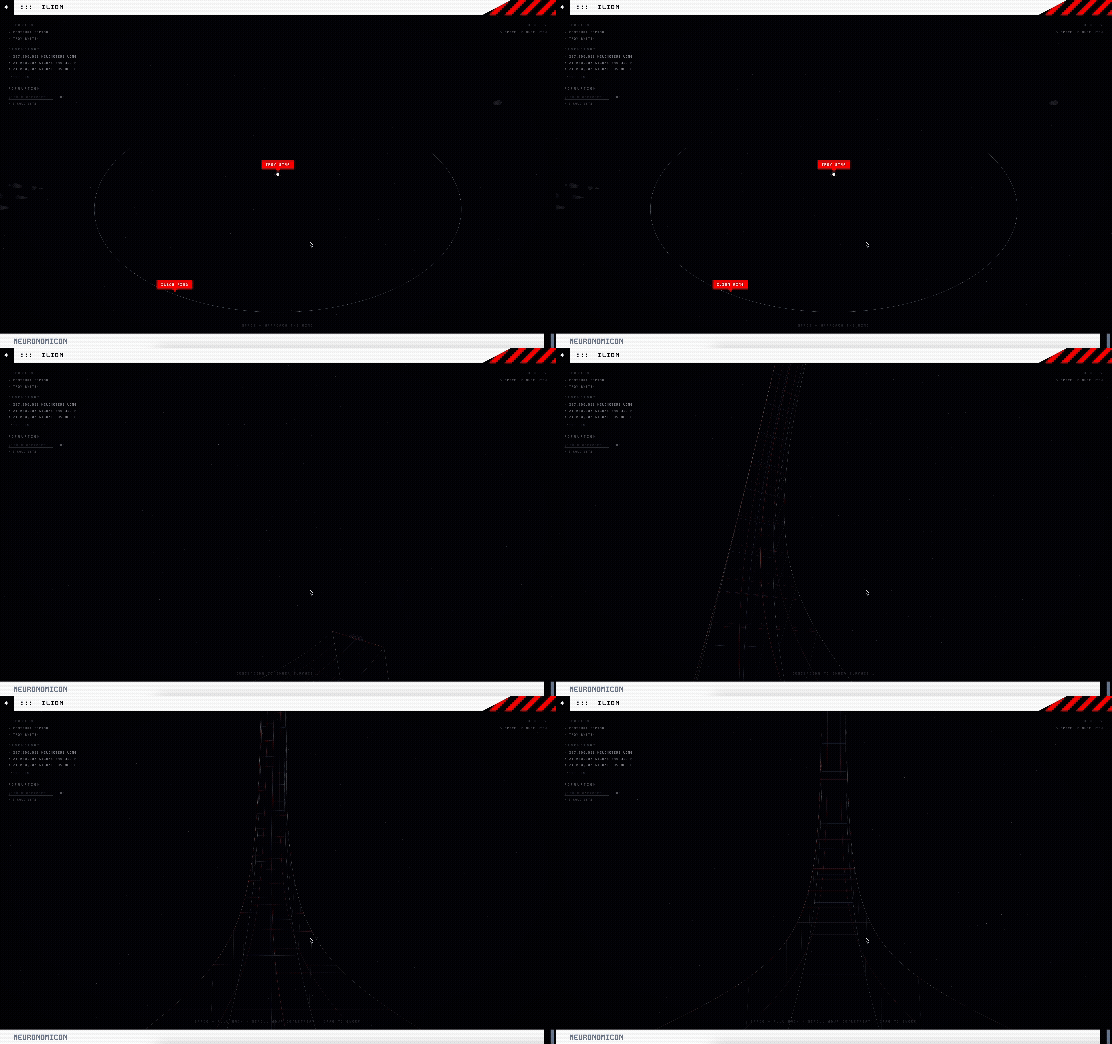
At orbital distance, viewing Ilion from space, the ring should read as a single thin arc. A line. But at drone distance, flying above the surface, you need to see the full structure: inner face, outer hull, cross-members, the 28-unit depth of the ring wall.
If you use the real dimensions at orbital distance, it looks like a glowing green disc. Wrong. If you use orbital-scale geometry in the drone view, you’re floating above a hairline. Also wrong.
The solution was two separate geometry systems, one for each scale, that crossfade as the camera transitions. The orbital representation is just a line. The drone representation is the full structure. They swap during the fly-in, so you never see both at once.
I didn't know it at the time, but there's a name for this in game development: LOD, Level of Detail. Standard technique. Every game engine does it. I reinvented it while trying to make a wireframe ring look right from two different distances.
But the reason I needed it here is the same reason I needed the diagram: AI can’t resolve ambiguity about what you actually need, it builds what the words describe, not what you imagine. The gap between those two things is always wider than you think.
What this means for building your world
Two rules I’ll carry forward:
If you can’t sketch it, your AI can’t build it. Not because the AI is limited, but because you don’t know what it looks like yet. The sketch isn’t for the AI. It’s for you. The act of drawing forces you to resolve the spatial relationships you’ve been glossing over in prose. So do it. On a napkin or photoshop. Quality doesn’t matter: the AI will handle that. But it needs the information.
One world needs multiple representations. The same setting looks completely different depending on the scale of observation. Ilion from orbit is a thin arc. Ilion from the surface is a city. These require different assets, different geometry, different production decisions, and you need to know which one you’re making before you start.
Expect the first outputs to be wrong in interesting ways. The wrong versions teach you things about your world you didn’t know you’d missed.
The ring is still a working progress. It’s incomplete. I still need to add buildings, tag my canon locations, and, and… Yeah. It will grow.
The important thing is that I can do it. And it’s becoming alive. That feels right.
Halo had a studio. Ringworld had a legend.
A fictional universe used to require a team, a budget, and years you didn’t have.
Now it requires a vision and the stubbornness to keep drawing diagrams until the AI understands you.
Whatever your world is, just build.
Grind Fighter is live on Royal Road, the ring you’re looking at is the world Beatrix lives in. Start with Chapter 1.